
Sequence modeling
Implemented the GRU encoder and diphone CTC pipeline, then explored skip-diphone and smoothness objectives.
NEURAL DECODING × MACHINE LEARNING
A better intermediate metric needs an end-to-end check.
THE IDEA
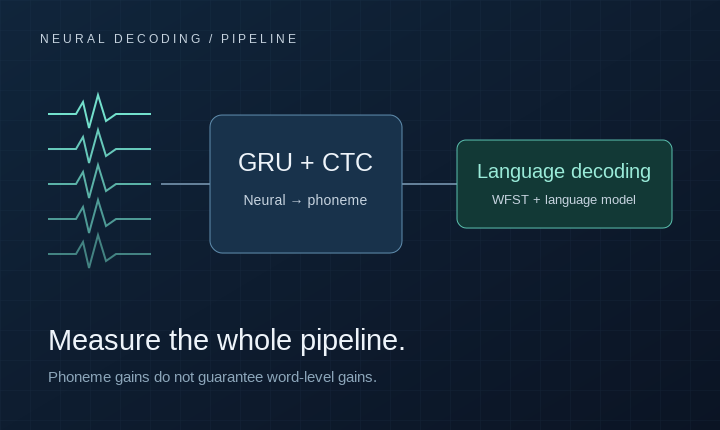
I built a PyTorch pipeline for intracortical speech decoding on the Brain-to-Text ’24 benchmark. A bidirectional GRU encoder feeds a diphone CTC decoder, with skip-diphone and smoothness-loss variants evaluated through a five-variant ablation study and Kaldi WFST decoding.
MY CONTRIBUTION
Implemented the GRU encoder and diphone CTC pipeline, then explored skip-diphone and smoothness objectives.
Ran five ablation variants to examine phoneme-level changes against the baseline.
Compared phoneme and word error rates and found that the phoneme-level gain did not carry over to word error after WFST decoding.
ENGINEERING CHALLENGE
The best variant reduced phoneme error rate from 20.48% to 19.75%, but this gain did not translate to lower word error. The baseline retained the best reported word error rate, 18.07%, with a 5-gram language model. The result made the decoding interface as important to examine as the neural model itself.
RESULTS & SCOPE
19.75% for the best variant, compared with 20.48% for the baseline.
The baseline remained best at 18.07% with a 5-gram language model.
Five model/loss variants evaluated in the course-project ablation study.
These are offline benchmark experiments. The lower phoneme error rate is not a claim of improved word-level performance or a live BCI demonstration.
Explore the decoding experiments