
Embedded intent decoding
Implemented filtering, feature extraction, and fixed-point Q18 LDA on an STM32F103. Three EMG channels feed a 20 Hz decision pipeline that emits NEXT_TARGET, CONFIRM, and ABORT events.
BIOSIGNALS × ROBOTICS
Let the person choose the goal. Let the robot handle the motion.
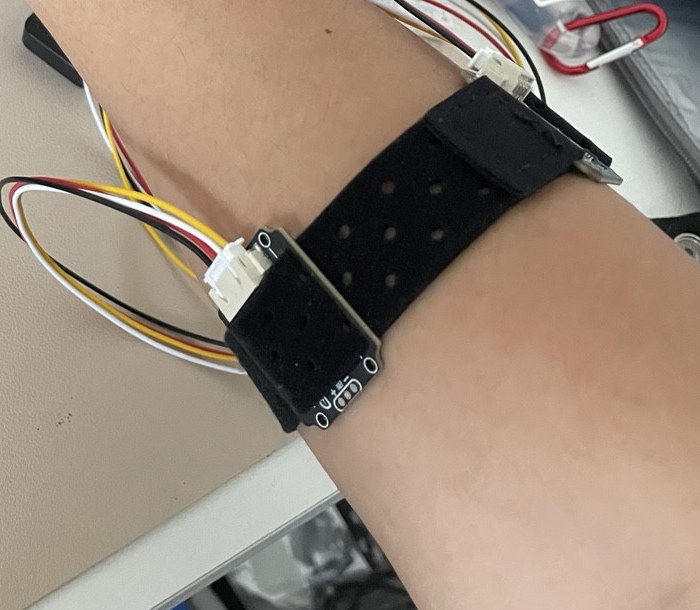 THE WEARABLE INTERFACE · REAL HARDWARE
THE IDEA
I am building a research prototype that connects a wearable EMG interface to shared-autonomy manipulation. The wearer selects, confirms, or aborts a task; the robot side manages target selection, motion planning, and handoff conditions. The intent interface runs on a real STM32, while arm motion has been verified on a simulated Panda.
MY CONTRIBUTION
Implemented filtering, feature extraction, and fixed-point Q18 LDA on an STM32F103. Three EMG channels feed a 20 Hz decision pipeline that emits NEXT_TARGET, CONFIRM, and ABORT events.
Built the ROS 2 interface and event gating between noisy physiological signals and the handoff state machine. REST emits no discrete event; stale inputs are gated before the controller acts.
Integrated object perception and passive-stereo localization with target selection. The shared controller supports a timer backend for logic checks and a MoveIt backend for the simulated Panda.
ENGINEERING CHALLENGE
A model can look accurate when training and evaluation share the same electrode placement. I evaluated by holding out an entire donning—one electrode application—rather than just a recording session. Across five donnings from one wearer, offline window accuracy was 93.3–95.1%. This tests a useful source of variability, while leaving cross-person and longer-term transfer open.
RESULTS & SCOPE
Three channels; fixed-point LDA; 20 Hz decisions on STM32F103.
93.3–95.1% offline window accuracy, one wearer and five electrode applications.
Zero discrete-intent false triggers in 10 minutes. The separate proportional view stream had six unintended direction excursions.
The ArUco pose baseline stays within about 1 cm of tape-measured distance up to 0.5 m. The markerless stereo path has bounded bench checks, not an absolute-accuracy figure.
MoveIt backend verified separately on a simulated Panda; synthetic integration also runs with a timer backend.
Physical grasping and handoff on the SO-ARM101 have not been validated. Light contractions remain unreliable, and the reported classification results are from one wearer. The discrete-intent false-trigger result does not establish zero unintended motion in the proportional view stream.
Read the design and evaluation logs