
Four CAN buses
Brought up three on-chip FDCAN peripherals and an SPI-attached MCP2518FD. Configured the clock tree and 1 Mbps bit timing to match the ODrive’s 87.5% sample point.
EMBEDDED × CONTROL
Predictable timing, reliable communication, and a controlled first movement.
THE IDEA
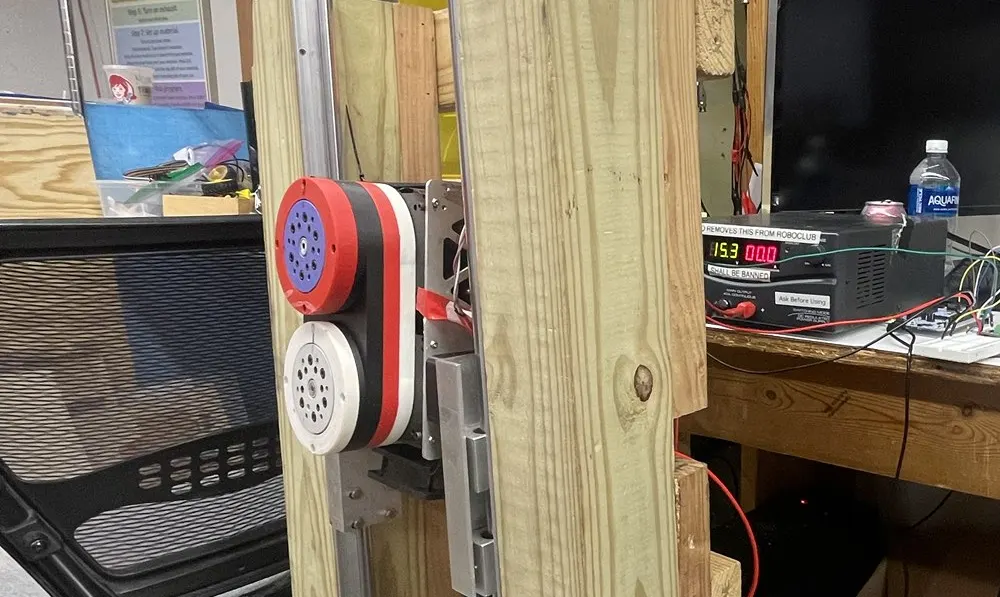
As a member of CMU Robotics Club’s Laika firmware team, I work on the embedded path between an STM32H723 and ODrive motor controllers. My contribution covers CAN bring-up and integration of the joint torque controller into FreeRTOS, with validation on a two-joint test leg.
MY CONTRIBUTION
Brought up three on-chip FDCAN peripherals and an SPI-attached MCP2518FD. Configured the clock tree and 1 Mbps bit timing to match the ODrive’s 87.5% sample point.
Integrated a PD joint torque controller into the FreeRTOS loop, linking joint feedback to motor torque commands.
Added bumpless start, an ODrive watchdog feed, and a zero-torque dry-run mode, then checked the integrated controller on a two-joint leg.
ENGINEERING CHALLENGE
A controller needs more than the right gain values. Communication settings, feedback, startup behavior, and watchdog timing all affect the physical result. I treated bring-up as a system task: establish the CAN links, exercise the zero-torque path, and validate the PD loop on the test leg.
RESULTS & SCOPE
Four buses configured for ODrive communication at 1 Mbps.
1 kHz PD joint torque controller integrated into FreeRTOS.
Two-joint test leg; bumpless start, watchdog feed, and dry-run path.
The validation described here is on a two-joint test leg. It does not establish full-quadruped walking performance. This is a team project; the contributions above describe my firmware work.
Explore the team firmware repository